

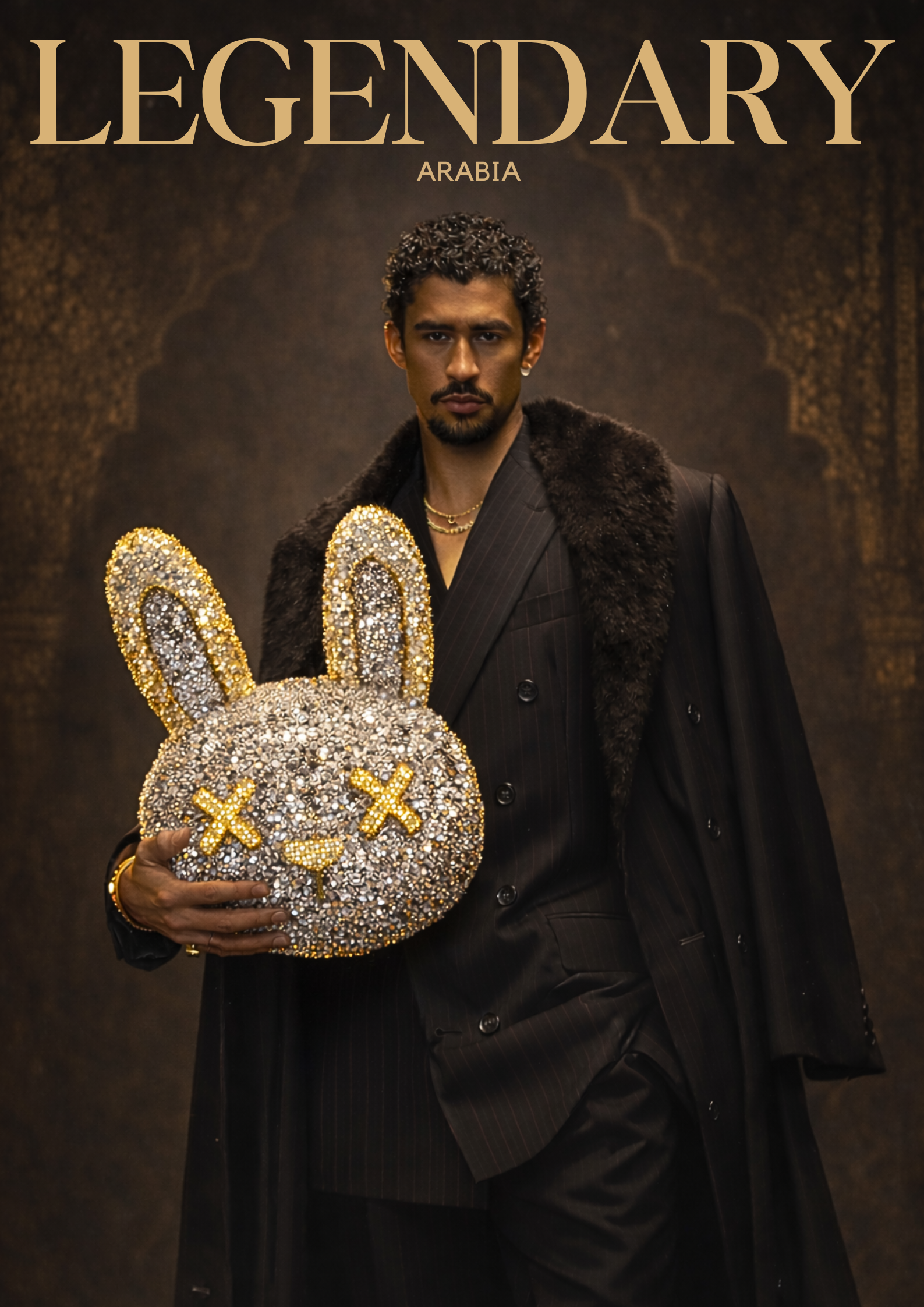
Legendary Arabia Exclusive
In 2026, the world witnessed a cultural phenomenon that didn’t just headline a stage — it redefined the very framework of global influence.
When Bad Bunny ascended the Super Bowl LX halftime show platform — performing primarily in Spanish — he didn’t just entertain millions. He challenged centuries of cultural assumptions about language, identity, and who gets to stand at the summit of global pop culture. What took decades for others to achieve, he did with authenticity, poetry, and relentless self-determination.
But to truly understand Bad Bunny’s rise — and why his impact matters to the world and to Legendary Arabia’s mission — you must go beyond the spectacle. His story isn’t merely about fame; it’s about ownership of narrative, authentic voice as global currency, and the power of rooted identity embraced on the world stage.

From San Juan to the World: A Radically Authentic Ascent
Benito Antonio Martínez Ocasio — the artist known worldwide as Bad Bunny — didn’t follow the established route to stardom. He didn’t sing in English to “fit in” with global pop. He owned his voice in Spanish, anchored in his Puerto Rican heritage, and turned what the industry once thought was a limitation into the most powerful asset of his career.
Most entertainers chase universal appeal by narrowing specificity. He did the opposite. He said, in essence:
“I will bring the world to me — on my terms.”
That choice is not just artistic — it’s strategic.
In an age dominated by algorithms and commodified visibility, Bad Bunny’s decision to retain authenticity while expanding influence reveals a new kind of cultural economics. It’s not just about reach. It’s about depth of resonance — cutting through cultural noise by speaking in a language whole communities feel as their own.
His albums have shattered global records. His work isn’t just consumed — it defines moments. He has won multiple Grammy Awards, including Album of the Year for Debí Tirar Más Fotos — the first Spanish-language album to ever receive that honor in the Academy’s history.
The Super Bowl Moment: A Cultural Declaration
To grasp the significance of Bad Bunny’s Super Bowl halftime performance is to recognize a tectonic shift in cultural power.
For decades, the Super Bowl stage was emblematic of American exceptionalism — a showcase of entertainment engineered for the mainstream. When Bad Bunny took that stage, singing predominantly in Spanish, he didn’t just perform. He centered a global audience around cultural specificity.
Millions of Hispanics across the United States and Latin America saw themselves reflected in a spectacle that had rarely honored their voices in such robust, unapologetic form. His performance became a symbol of representation, pride, and cultural dignity — and sparked heated debates about language, identity politics, and inclusivity in global media.
In the aftermath, streaming numbers surged. Spanish-language search queries and even language-learning platform engagement increased as audiences looked to understand the context and the lyrics that had moved them so profoundly.
This wasn’t happenstance or novelty. It was strategic — a deliberate reclaiming of space.
Beyond Music: Fashion, Identity, and Norms of Masculinity

Bad Bunny’s influence is multidimensional. He hasn’t merely redefined Latin music — he has reoriented global pop culture.
His fashion choices — painted nails, flamboyant silhouettes, gender-fluid expressions of style — challenge entrenched norms of masculinity. In a genre historically steeped in hyper-masculine imagery, Bad Bunny’s presence has opened up room for nuanced identity expression without sacrificing cultural relevance.
This is more than style. It’s cultural language.
In choosing attire that defies stereotypes, he communicates something essential: identity isn’t monolithic. It’s expressive. It’s fluid. And it can be powerful.
His influence on fashion has moved beyond stage costumes into streetwear and brand collaborations, echoing his cultural philosophy — that self-presentation is part of your story, not a distraction from it.
The Authenticity Engine: Why His Narrative Resonates
Bad Bunny’s enormous global relevance is not random. It’s engineered through consistency. He did not start with virtue signaling or corporate framing — he started with self-expression anchored in personal truth.
Every song, style, and public gesture felt like an authentic extension of who he is: a Puerto Rican artist with a vibrant cultural identity, a voice rooted in lived experience, and a worldview shaped by the complexities of belonging and expression.
This authenticity manifests in unexpected ways:
- Lyrics that explore love, vulnerability, and socio-political reality — without diluting emotional truth for mass consumption.
- Public stances on identity and representation that resonate internationally while remaining grounded in his own narrative.
- Community resonance that turns followers into participants — not just consumers — in his cultural movement.
In the current media landscape, where influence is often commodified and sanitized, Bad Bunny’s authenticity is fiercely disruptive. It reminds us that real power doesn’t emerge from mass appeal alone — it emerges from uncompromised individuality.
Bad Bunny as Blueprint: Culture as Strategy
At the core of Bad Bunny’s success lies an insight that Legendary Arabia champions deeply: Culture is not optional — it is strategic infrastructure.
For founders, creators, and cultural architects, his career provides a playbook:
- Anchor in authenticity
- Resist dilution for mass conformity
- Build community, not just audience
- Turn cultural specificity into global relevance
- Lead with identity, not imitation
In an age of global homogenization, Bad Bunny demonstrates that clarity of identity travels farther than compromise. True influence is not about pleasing everyone — it’s about being essential to those who matter.
This is not merely celebrity strategy. It’s cultural economics.

Latin Identity in the New Global Order
Bad Bunny’s rise coincides with a global shift in how culture is consumed, valued, and understood.
For decades, Western pop culture norms assumed assimilation — that to be global, you must conform to dominant language and aesthetics. Bad Bunny rejected that paradigm. In doing so, he didn’t just win charts — he altered expectations.
Today, Spanish is no longer a barrier to global mainstream success. Bad Bunny proved it is an asset. His victories — Grammy Awards, record streaming numbers, cultural impact — signal a fundamental recalibration in global media: you do not need to soften your roots to be world-renowned.
Legacy and the Future of Influence
Bad Bunny is not simply a musician. He is a model for what influence looks like in the 21st century.
His artistry, cultural resonance, and unfiltered identity are lessons for creators, entrepreneurs, leaders, and entire communities:
• Your voice is your legacy.
• Your identity is your fortress.
• Visibility without authenticity is hollow.
• Power emerges when culture is owned, not chased.
In a world flooded with followers and impression counts, Bad Bunny reminds us that lasting influence isn’t about reach — it’s about resonance.
Final Thought — A Cultural Horizon Shift
Bad Bunny didn’t arrive at the summit because he mimicked the past.
He reached the summit by bringing his roots to the world.
In doing so, he reshaped not just pop culture — but the rules of cultural capital.
As Legendary Arabia documents icons of our era — those who define the world rather than follow it — Bad Bunny stands not as a moment, but as a movement: a living blueprint for identity as power in the global age.